
Fitting Room Cleaning Standards That Protect Retail Customer Trust
Fitting rooms are private, high-contact spaces where shoppers decide whether a store feels cared for. A stray tag, dusty bench, mirror smudge, or full wastebasket can create doubt even when the sales floor looks polished. Fitting Room Cleaning Standards That Protect Retail Customer Trust give retail teams a repeatable way to spot issues, respond between visits, and make the experience feel consistently welcoming.
This guide explains what a fitting room standard should cover, how to distinguish quick resets from detailed cleaning, and how to build a practical checklist for attendants and cleaning teams. It also addresses garment-handling boundaries, safe product use, inspection frequency, peak-period response, and the questions to ask when comparing cleaning providers. The aim is not to promise a sterile retail environment; it is to create visible order and sensible hygiene practices without damaging fixtures, textiles, or customer privacy.
Use the frameworks below to tailor a routine to your store’s layout, traffic, materials, and operating hours. In Chicago, weather and seasonal shopping patterns can also affect tracked-in soil and visit volume, so review the plan as conditions change.
Begin with the shopper’s view of a fitting room
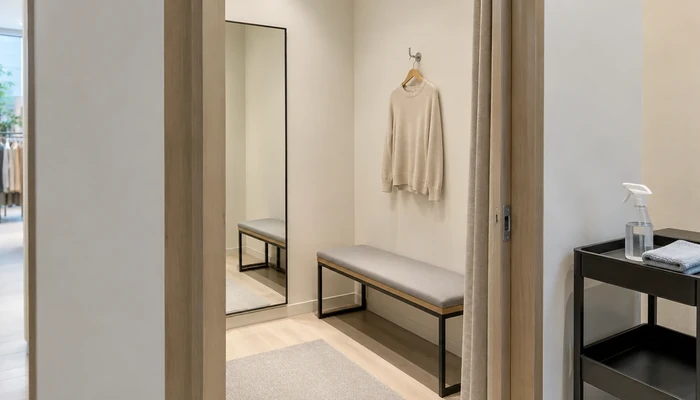
A useful standard starts with the details customers notice immediately. Before setting task frequencies, walk through each fitting room as if you were entering it to try on clothing. Look at the door, hooks, seat, mirror, floor, lighting, and the route back to the sales floor. Then check the room from different angles: mirror marks can be difficult to see head-on, while debris may collect along the base of a bench or in a corner.
Customer trust depends on both visible condition and predictable response. A room may be clean at opening but need attention after several uses. An effective program therefore combines scheduled cleaning with quick checks during trading hours. Staff should know what they can handle immediately, what requires a cleaning team, and how to take a room out of use if there is a spill, broken fixture, or other safety concern.
Identify the first-impression surfaces
Prioritize surfaces that shape the first few seconds of the visit. The mirror should be free of obvious fingerprints and streaks; the seat or bench should have no visible debris; and the floor should be clear of tags, packaging, and tracked-in grit. Hooks, handles, and room controls deserve focused attention because customers touch them repeatedly.
- Check mirrors under the room’s normal lighting, not only under bright cleaning lights.
- Look for loose threads, price tags, and lint on seats and floors.
- Confirm that hooks and shelves are secure and free of visible residue.
- Make sure the entrance, door swing, and exit path are unobstructed.
Separate appearance from hygiene tasks
Some tasks improve appearance, while others reduce soil on frequently handled surfaces. Both matter, but they are not interchangeable. Straightening a curtain does not clean its track; emptying a bin does not remove residue from its lid. A checklist should name the action and surface clearly, rather than rely on an open-ended instruction such as “tidy room.”
For a broader view of how customer-facing spaces influence perceptions, see this discussion of clean, well-maintained customer service areas. Fitting rooms need their own more focused routine, but they share the same basic principle: shoppers notice whether a business maintains the spaces they use.
Map each room into cleanable zones
Fitting rooms are small, but their surfaces have different uses and care requirements. Dividing each room into zones helps prevent skipped details and keeps the work sequence logical. A typical room includes the entrance and door, customer touchpoints, seating and ledges, mirrors and other vertical surfaces, the floor, and any waste or garment-return point. The exact map depends on the store’s design.
During setup, record surface materials and any manufacturer care instructions. A mirror, painted wall, laminate bench, metal hook, and fabric curtain may need different products or tools. If the store has multiple room styles, document the differences rather than assuming one method suits every finish.
Use a room map to make scope visible
A simple diagram or numbered list can show what “complete” means. Assign a location code to each room and use the same labels on inspection logs, work orders, and supply requests. This is especially helpful in larger stores where fitting rooms sit in separate departments or on different floors.
- Entrance zone: door, handle, frame, and nearby wall marks.
- Touch zone: hooks, controls, handles, and approved high-contact points.
- Customer-use zone: bench, shelf, and other supplied surfaces.
- Visual zone: mirror and any exposed glass or display surface.
- Floor and waste zone: floor edges, corners, and waste receptacle.
Mark delicate, restricted, and staff-only areas
Not every item inside a fitting room belongs in the cleaning scope. Clothing left behind should follow the store’s recovery process, not be treated as cleaning debris. Likewise, staff devices, security equipment, and product displays may need handling by authorized employees. Note any items that cleaners should avoid moving, and identify who to notify when a fixture needs repair.
For more on coordinating the cleanliness of customer-facing areas with daily store operations, the resource on managing sales and customer-service area cleanliness can help frame responsibilities across the wider retail environment.
Set a dependable reset sequence after each fitting
A between-customer reset is not the same as a full cleaning visit. Its purpose is to restore order, remove obvious debris, and leave the room ready for the next shopper. A clear sequence makes the reset faster and reduces the chance that staff will overlook a visible problem while handling returns or assisting customers.
Start only after the shopper has left and follow the retailer’s privacy and garment-handling procedures. Avoid rushing into an occupied room or moving personal belongings. If an item appears to have been left behind, alert the appropriate team member and follow store policy.
Use a short, repeatable reset checklist
- Confirm the room is vacant and safe to enter.
- Collect tags, packaging, and other obvious non-merchandise debris.
- Place garments in the designated return location according to store procedure.
- Check the mirror, bench, hooks, and floor for visible marks or debris.
- Address minor surface soil with the approved method, or flag it for cleaning.
- Check for odors, spills, damage, and missing supplies or fixtures.
- Return the room to its ready state and record issues that need follow-up.
Know when a reset is not enough
A reset should not be used to conceal a spill, sticky residue, persistent odor, or a surface that requires a product-specific cleaning method. Close or mark the room according to store procedure when it cannot be made ready safely and promptly. Notify a supervisor or cleaning lead if the concern requires more time, special equipment, or maintenance.
Small, repeated omissions tend to show up at room edges and touchpoints. A short checklist is most useful when staff have time to complete it and managers occasionally observe the process. Avoid adding so many steps that the reset becomes impractical during a busy sales period.
Choose the right response for each surface
Products and tools should match the surface, the type of soil, and the intended task. Using one strong product on every fixture can damage coatings, leave residue, or create an unpleasant odor. Conversely, a dry cloth may spread oily marks rather than remove them. Follow the product label and the surface manufacturer’s directions, and ask the responsible manager when instructions are unclear.
Cleaning and disinfecting are distinct actions. Cleaning removes soil; disinfecting uses a product labeled for that purpose under specified conditions. Where disinfection is included in the protocol, staff need to follow the label’s directions, including required contact time. Do not imply that a surface is disinfected merely because it was wiped.
Match tools to the work
- Use a suitable glass cloth and approved glass product for mirrors, avoiding overspray onto nearby materials.
- Use clean cloths for touchpoints and replace them when soiled instead of carrying soil from one room to another.
- Choose floor tools appropriate to the floor finish and the amount of grit or debris present.
- Use separate tools for waste handling and customer-contact surfaces.
- Store products securely and keep them away from garments, customers, and merchandise.
Protect finishes and people
Never mix products unless the label explicitly permits it. Keep ventilation in mind, avoid leaving wet floors unmarked, and do not use a product that could leave a slippery or tacky surface. If a customer enters, stop work and follow the store’s procedure for clearing the area safely.
For a useful general explanation of how commercial teams can approach soil removal and disinfection, review commercial cleaning and disinfection techniques. The relevant method for a fitting room still depends on the surfaces, product instructions, and the retailer’s own policy.
Inspect high-contact points without overpromising
Touchpoints merit attention because customers and staff handle them frequently. That does not mean every touchpoint requires the same product or treatment every time. Build a list based on the room’s design and observed use, then align the method and frequency with the store’s risk assessment and product directions.
Common points include door handles, hooks, latches, bench edges, light switches, and any customer-operated control. A mirror may collect fingerprints but is not usually handled in the same way. This distinction helps teams prioritize effort instead of applying an identical procedure to every surface.
Track repeat soil and missed points
Use periodic observations to spot patterns. If a hook repeatedly has residue, check whether the tool reaches its shape and whether the surface finish requires a different method. If floor debris reappears soon after cleaning, consider the entrance mat, the garment-return process, and the timing of checks rather than simply increasing product strength.
- Record the room, time, observed issue, and corrective action.
- Separate one-off incidents from recurring patterns.
- Review trends with store staff and the cleaning lead.
- Update the checklist when room layouts or materials change.
Use clear language in inspection records
“Looks good” is difficult to verify. Better notes identify the surface and condition, such as “mirror clear under standard lighting” or “bench free of visible debris.” Records should stay concise and operational. They should not claim a room is germ-free or guarantee that cleaning eliminates all health risks.
Build a schedule around use, not a fixed guess
Fitting room demand changes by hour, day, department, promotions, season, and store layout. A schedule should therefore include both planned tasks and event-based checks. The correct frequency cannot be set from a universal number; it should reflect observed traffic, room count, staffing, customer expectations, and the time needed to complete tasks safely.
Start with an opening inspection, then define checks during operating hours and a closing or after-hours cleaning scope. Managers can adjust the cadence during peak periods, after a spill, or when weather brings more grit indoors. In Chicago, slush and road salt during winter can increase floor soil near entrances and may affect fitting room floors as well.
Use a tiered frequency plan
| Timing | Typical focus | How to adjust |
|---|---|---|
| Opening | Room readiness, visible surfaces, floors, supplies, and reported defects | Check all rooms before customer use; document anything that cannot be corrected immediately. |
| During trading | Quick resets, visible debris, touchpoint concerns, and spill response | Increase checks when use rises or when a department is especially busy. |
| Closing or scheduled service | More complete surface cleaning, waste handling, edges, and floor care | Match the scope to materials, traffic, and the time available before reopening. |
| Periodic review | Recurring soil, finish condition, checklist accuracy, and staffing needs | Revise the plan when trends, layouts, or customer patterns change. |
Make peak-period coverage realistic
When the store is busy, a long checklist may not be realistic after every visit. Keep a short readiness reset for attendants and assign fuller work to scheduled cleaning periods. Define the escalation path for spills or unusual contamination, and make sure staff know who can close a room temporarily.
More frequent attention can help maintain presentation, but it does not replace appropriate task methods. Too many rushed wipes may leave streaks or residue. Review both the result and the process rather than counting completed checks alone.
Coordinate garment recovery, privacy, and room readiness
Fitting rooms serve a retail function as well as a cleaning function. Cleaning staff and attendants may encounter garments, personal items, or a customer who needs assistance. Store policy should clearly distinguish cleaning responsibilities from merchandise recovery, loss prevention, and customer service.
Agree on what happens when someone leaves a garment behind, when a tag or security device is damaged, or when a customer reports a concern. Cleaning teams should not guess whether an item is discarded, returned to stock, or sent for inspection. A clear handoff keeps the room moving while protecting merchandise and customer privacy.
Keep the service boundary clear
- Do not sort or return merchandise unless the retailer has specifically assigned that task.
- Use the store’s lost-property process for personal items.
- Keep cleaning carts, tools, and products outside customer areas when not in use.
- Do not photograph or record customer-related material in a fitting room.
- Report damage, spills, or potential safety concerns through the agreed channel.
Agree on handoffs before the first shift
A short briefing should explain who inspects rooms, who handles garments, which supplies are permitted, and how urgent issues are reported. For stores with several departments, identify whether each attendant covers a defined group of rooms or whether a central team responds to calls. Keep the instruction visible to authorized staff and update it when responsibilities change.
Clear role boundaries also make vendor discussions more productive. A cleaning proposal should state whether attendants’ resets, after-hours cleaning, floor care, and supply replenishment are included or assigned to store employees.
Measure consistency with observations and useful records
Quality monitoring should check whether the room is ready for customers and whether the agreed process is being followed. A tally of completed tasks alone cannot show that mirrors are streak-free or that a wet floor was marked. Combine brief visual inspections with records of issues, corrective actions, and repeat findings.
Keep the system proportionate. A small store may use a simple room log; a larger operation may need a digital inspection form. Either way, staff should be able to report a problem without creating a complicated administrative burden.
Use a practical inspection scorecard
- Ready: no visible debris, obvious marks, or unresolved safety issue.
- Needs attention: a correctable issue is present and has been assigned.
- Out of service: an unresolved spill, defect, or other issue makes customer use inappropriate.
Record the room identifier, time, concern, person responsible for follow-up, and resolution where appropriate. Avoid collecting unnecessary personal information. A manager can sample rooms at different times to see whether standards hold beyond opening checks.
Look for trends rather than blame
Repeated marks may point to a product or tool mismatch. Frequent litter may indicate that the bin is poorly placed or needs a different service interval. Rooms regularly left out of service may reveal a maintenance problem or a gap in staffing. Use the evidence to adjust the system, coach staff, or request repairs.
A concise review every few weeks, or after a major layout change, can keep the procedure relevant. Ask attendants and cleaners which steps are difficult to complete during peak use. Practical feedback often reveals where a checklist needs clarification.
Compare cleaning coverage without confusing the scope
Retail cleaning can involve daily presentation, periodic detailed work, floor maintenance, and response to unexpected incidents. Fitting room routines are one part of that wider plan. When comparing providers, ask what the fitting room scope includes and how it fits with the rest of the store rather than assuming that “retail cleaning” means the same thing in every proposal.
For a wider perspective on how cleaning programs differ across commercial settings, consult the elements of a professional commercial cleaning program. The page addresses broader commercial considerations; your fitting-room plan should still name its own tasks, timings, and responsibilities.
Compare deliverables side by side
| Scope item | Clarify before agreement |
|---|---|
| Between-visit resets | Are these handled by store attendants, the contractor, or a shared process? |
| After-hours tasks | Which rooms, fixtures, floors, and waste points are covered, and how often? |
| Products and tools | Who supplies them, and how are surface compatibility and product directions confirmed? |
| Issue reporting | Who receives reports about spills, damage, missing supplies, or rooms taken out of use? |
| Quality checks | What is inspected, how often, and how are corrective actions recorded? |
| Scope changes | How are seasonal adjustments, added rooms, or special events handled? |
Look for operational clarity
A useful proposal describes tasks in observable terms, identifies exclusions, and explains how the team communicates. It should also account for access, operating hours, room count, floor types, and any restrictions on product use. Ask how staff are briefed on site-specific procedures and how service quality is reviewed.
CHI Cleaning Services provides cleaning for homes, offices, and specialized facilities. Retail operators considering outside support can review the company’s retail store cleaning service to understand whether the available scope fits their operational needs.
Recognize problems that call for a process change
Some fitting room problems return because the routine does not match how the space is used. A persistent odor, for example, may require investigation of waste handling, ventilation, a spill, or a material that has absorbed odor. Repeated streaks may result from the wrong cloth, excess product, or poor drying technique. A checklist should help staff identify the issue and escalate it, not encourage them to repeat an ineffective action.
Watch for patterns across rooms and shifts. A defect in one room may be isolated; the same complaint across several rooms could point to a supply, training, or scheduling issue. Describe the condition precisely and involve the store manager or building contact when cleaning alone is unlikely to solve it.
Escalate conditions that ordinary cleaning cannot resolve
- Persistent odor after the room has been cleaned and waste removed.
- Recurring sticky residue or a stain that may affect the finish.
- Loose hooks, broken latches, damaged mirrors, or unstable seating.
- Wet floors, unknown spills, or any condition that could cause a slip.
- Product reaction, discoloration, or unexpected surface damage.
Protect surfaces when addressing stubborn marks
Do not scrape, scour, or apply a stronger chemical without checking the surface guidance. Some stains and damage cannot be fully reversed, and an aggressive attempt may worsen them. If the mark remains after the approved method, document it and request direction from the responsible manager or maintenance contact.
Making room closure and escalation straightforward protects both customers and staff. It also prevents pressure to return a space to use before it is safe or presentable.
Adapt the standard to layout, traffic, and materials
There is no single fitting room schedule or checklist that suits every store. A small boutique with a few rooms may rely on frequent staff checks and a scheduled closing clean. A larger retailer may need department-level assignments, room identifiers, and a designated response team. Different floor finishes, curtains, seating, and mirror arrangements also affect the work.
Start with an on-site assessment. Count the rooms, note the surfaces, estimate when customer use is heaviest, and identify the distance between rooms and supplies. Then test the proposed routine during an ordinary shift and a busier period. Adjust steps that are too slow, ambiguous, or impossible to complete without disrupting service.
Use a short site assessment
- List rooms by department, floor, and identifier.
- Record floor, seating, mirror, curtain, and fixture materials.
- Observe typical and peak use periods.
- Identify staff coverage, product storage, and access constraints.
- Note recurring soil, customer feedback, and maintenance concerns.
- Set an initial checklist and review it after a trial period.
Revisit the plan when conditions change
Reassess after a renovation, seasonal display change, new floor treatment, or change in store hours. A new curtain material or bench finish may require a different care method. A promotion or holiday period may increase fitting room traffic enough to justify more frequent readiness checks.
For retailers in Chicago, winter entry conditions and summer event periods may create different patterns of tracked-in soil and foot traffic. Use actual observations rather than assumptions about the season. The objective is a dependable standard that fits the store’s real operating day.
Use this fitting room readiness checklist
The following checklist brings the main principles together. Adapt it to the store’s product labels, finish-care directions, privacy policy, and division of duties. It is a working tool—not a claim that every room requires identical treatment or that visual checks guarantee a particular health outcome.
Opening and scheduled inspection
- Room is accessible, safe, and free from unresolved spills or hazards.
- Mirror and visible surfaces are free of obvious marks and residue.
- Bench, hooks, shelves, and door hardware appear clean and secure.
- Floor edges and corners are checked for tags, lint, and tracked-in debris.
- Waste receptacle is serviced according to the store’s procedure.
- Supplies, if provided, are present and in appropriate condition.
- Damage, odor, or repeat concerns are recorded for follow-up.
Between-customer readiness
- Wait until the room is vacant and follow store privacy procedures.
- Handle garments and personal belongings only under store policy.
- Remove visible debris and restore the room’s normal arrangement.
- Check the mirror, seating, hooks, and floor from the customer’s view.
- Report a spill, defect, or persistent soil rather than hiding it.
- Return the room to service only when it is safe and ready.
End-of-shift review
- Complete the agreed fuller cleaning scope with surface-appropriate methods.
- Replace soiled cloths and put tools away in their designated storage area.
- Record outstanding repairs, supply needs, and unresolved concerns.
- Share repeat issues with the supervisor or cleaning lead.
Frequently asked questions about fitting room standards
How often should a fitting room be cleaned?
Use a mix of opening checks, between-customer resets, scheduled cleaning, and event-based response. The right frequency depends on traffic, layout, materials, staffing, and observed soil. Review actual conditions and adjust the plan rather than relying on a universal interval.
Should fitting rooms be disinfected after every shopper?
Not automatically. Cleaning and disinfecting are different tasks, and product use should follow the retailer’s risk assessment, policy, label directions, and surface compatibility. A reset can address visible debris and readiness without making an unsupported claim that every surface has been disinfected.
Who should remove clothing left in a fitting room?
The store should define this responsibility. In many operations, attendants or sales staff handle garment recovery under merchandise procedures, while cleaning staff focus on assigned surfaces and waste. The written process should cover misplaced garments and personal belongings.
What should staff do when a room has a spill?
Follow the store’s safety and incident procedure. Keep customers away from a potentially unsafe area, notify the designated person, and use the approved response for the material involved. Do not return the room to use until the concern has been handled and the floor is safe.
Which products are appropriate for mirrors and benches?
There is no universal product for every mirror, bench, or finish. Follow the manufacturer’s care directions and the product label, and avoid overspray or methods that may leave residue or damage a coating. Test or seek approval when material compatibility is uncertain.
How can a retailer check cleaning quality?
Use short visual inspections at different times, with clear criteria for room readiness and a simple way to record issues and corrective actions. Look for repeat patterns across shifts and rooms. Completed forms matter less than whether the agreed standard is consistently visible.
Does a professional cleaning visit replace staff resets?
Usually, the two tasks serve different purposes. Store staff may restore order between customer visits, while scheduled cleaning addresses a defined scope at agreed times. The written plan should state who does each task so that responsibilities do not fall between teams.
Make the standard useful on the sales floor
Fitting room cleaning standards work best when they are specific, visible, and practical during real store hours. Map the rooms, distinguish resets from scheduled cleaning, match methods to materials, and define who handles garments, spills, defects, and inspection records. Then use observations to refine the frequency and scope as traffic changes.
Start with a small, clear checklist and test it with the people who use it. A consistent process supports a more reassuring shopper experience, but no checklist can replace sound judgment, product-label compliance, or prompt maintenance. Retailers can review retail cleaning coverage when they want to compare operational support for fitting rooms and other customer-facing areas.
About CHI Cleaning Services
CHI Cleaning Services supports a range of cleaning projects, including recurring house cleaning, deep cleaning, move out cleaning, office cleaning, and facility cleaning. The company emphasizes trained staff, consistent checklists, appropriate professional products and equipment, attention to high-touch areas, and clear communication. CHI Cleaning Services helps households and businesses in Chicago, Illinois and nearby areas keep their spaces clean and healthy. Service scope and scheduling depend on the property, condition, and client requirements.
cleaning service in chicago, boutique cleaning, retail floor cleaning Cleaning Services Chicago, storefront cleaning Glendale Heights IL, boutique cleaning Bradley IL, retail store cleaning West Loop IL, store cleaning Palatine, shop cleaning Avondale IL, retail floor cleaning Park Ridge IL, retail cleaning Great Lakes