Risk Assessment in Office Cleaning: Building a Safer, Healthier Workplace
Every office space holds unique cleaning challenges—shared desks, high-touch surfaces, busy restrooms, kitchenettes, and individualized work habits all affect workplace health. Yet, few decision makers realize that risk assessment in office cleaning is not just about visual tidiness—it’s the foundation for safer buildings, regulatory compliance, and overall business continuity. In this guide, you’ll discover a practical, step-by-step approach to risk assessment in office cleaning, including proven tools, real-world protocols, and ways to evaluate how a professional cleaning company like CHI Cleaning Services conducts thorough safety reviews as part of every routine, deep, or recurring cleaning service. Whether you’re a property manager, business owner, or simply seeking a higher cleaning standard for your Chicago office, you’ll learn what matters, how to compare cleaning providers, and how to take action.
Core Principles of Risk Assessment for Office Cleaning
Effective office cleaning starts with a clear understanding of workplace hazards and vulnerabilities. Risk assessment involves systematically identifying what could cause harm, the likelihood of that harm, and the measures needed to prevent it. These principles set the groundwork for every cleaning task, from dusting a desk to deep-cleaning high-traffic areas:
- Hazard identification: Pinpoint sources of possible harm (e.g., chemical exposure, slip hazards, sharp objects, biological contaminants).
- Exposure analysis: Consider who might be at risk—employees, visitors, cleaning staff, and even pets in pet-friendly offices.
- Risk evaluation: Assess the severity and likelihood of incidents based on tasks, office layout, and previous incidents.
- Control measures: Define what can be done to eliminate or reduce each risk, creating clear step-by-step procedures and selecting the right equipment.
- Continuous review: Update the assessment as office conditions, staff, or regulations change.
Identifying Office-Specific Cleaning Hazards
Unlike residences, offices present unique environments for risk assessment. Consider how open-plan layouts, employee density, shared electronics, and even flexible workspaces can amplify risks:
- Heavy foot traffic spreads dirt, moisture, and germs.
- Communal devices (phones, copiers, handles) become high-touch infection points.
- Restroom facilities require strict hygiene protocols and robust cleaning chemicals.
- Kitchens increase risk of slips (from spills), cross-contamination, and pest activity.
- Secure document areas introduce privacy/confidentiality requirements for cleaning staff.
CHO Cleaning Services tailors risk assessments by area, ensuring mitigation plans fit both high-visibility spaces and low-traffic or specialty locations.
Key Regulatory Standards Affecting Office Cleaning Risk Management
Legal and industry standards shape how risk assessments are performed. In Chicago and throughout the U.S., office cleaning safety is guided by frameworks such as:
- OSHA cleaning and personal protective equipment (PPE) regulations (read OSHA PPE guidance).
- Centers for Disease Control (CDC) infection control recommendations for shared spaces.
- Local health department directives and building management protocols.
Professional cleaning teams must stay up-to-date with evolving mandates, especially during public health events. Deliberate risk assessment ensures all activities remain compliant and safe.
How Professional Cleaners Perform a Risk Assessment: Workflow Overview
Reputable providers use a structured workflow before, during, and after cleaning:
- Pre-service safety walk: Inspect the office with facility management to identify hazards, access issues, or sensitive areas.
- Cleaning plan creation: Develop and document cleaning schedules, PPE requirements, approved supplies, and restricted zones.
- Product review: Verify chemicals are safe for the office’s surfaces, air quality, and allergy risks.
- On-site execution: Cleaning crews carry out tasks with appropriate PPE, signage (e.g., wet floor signs), and protocols for hazardous waste.
- Post-service review: Log completed tasks and incidents for ongoing risk mitigation.
Critical Risk Factors in Office Cleaning Tasks
Not all cleaning tasks have the same risk profile. Key high-risk scenarios include:
- Handling strong cleaning agents or mixing chemicals improperly.
- Working at heights (dusting ceiling fixtures, cleaning vents).
- Wet floor situations (mopping, kitchen cleaning) that create slip hazards.
- Biohazard touchpoints (restrooms, breakrooms, waste disposal areas).
- Sharps or glass disposal (often overlooked in regular cleaning routines).
A thorough risk assessment weighs the occurrence and severity of each task for targeted controls, not just blanket precautions.
Personal Protective Equipment (PPE): Choosing and Using the Right Gear
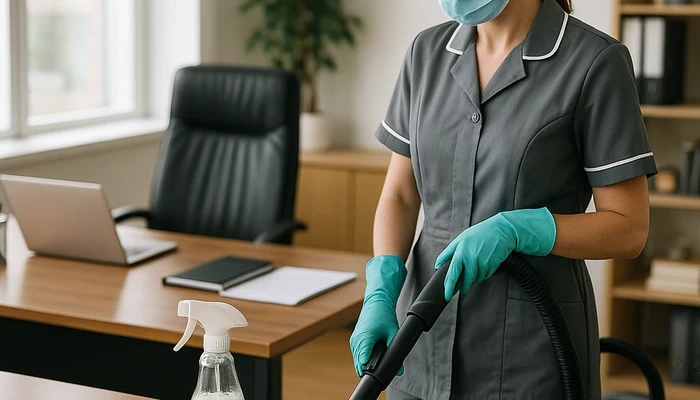
PPE shields cleaners from chemical, biological, and physical risks. Risk assessments determine exactly which PPE must be worn for each office cleaning task:
- Gloves: Disposable nitrile or vinyl, changed between tasks/rooms.
- Masks and respirators: Required in poorly ventilated spaces, dusting, or handling aerosols.
- Eye protection: When using sprays or handling cleaning agents above head level.
- Non-slip footwear: Reduces injury risk during wet cleaning.
- Aprons or gowns: Protect against chemical or biological spills.
For a detailed explanation of PPE and compliance, refer to OSHA’s PPE guidelines.
Sample Risk Assessment Table for Common Office Areas
| Office Area | Typical Hazard | Risk Level | Control Measures |
|---|---|---|---|
| Breakroom/Kitchen | Slips from spills, cross-contamination | Moderate | Non-slip mats, color-coded cloths, strict procedure |
| Restroom | Biohazards, chemical burns | High | Gloves, disinfectant protocols, warning signage |
| Workstations | Touchpoint germs, clutter hazards | Low | Daily surface disinfection, clear desk policy |
| Reception/Entry | Slip hazards from weather, germ spread | Moderate | Entrance mats, routine sanitization |
| Storerooms | Stacked items, trip hazards | Variable | Organized storage, restricted access |
Designing Office Cleaning Schedules Based on Risk Assessment
Frequency and scope should be risk-driven, not just routine. Cleaning plans that reflect risk assessment will:
- Increase frequency in high-traffic or high-touch areas.
- Use specialized products and PPE for sensitive zones.
- Document completed tasks for accountability and auditing.
For deeper cleaning or one-time needs (such as post-illness or seasonal deep cleans), consider a Deep Cleaning service for maximum risk reduction.
Evaluating Cleaning Products and Chemical Safety
Risk assessments must consider the safety, efficacy, and regulatory compliance of all chemicals used. Factors include:
- Surface compatibility: Avoid damage to electronics, stone, or finished wood.
- Employee allergies: Select unscented or hypoallergenic options if known allergies exist.
- Proper storage: Chemicals stored securely, away from food and business supplies.
- Labeling and Safety Data Sheets (SDS): Required for every product onsite for staff review.
Using the wrong products can increase risk, not reduce it. Partnering with professionals ensures compliance and safety.
Staff Training, Supervision, and Incident Reporting
Cleaning staff training is a core component of effective risk management. A comprehensive program includes:
- Practical training on each cleaning protocol and specific hazards of the office layout.
- PPE use, disposal, and proper hand hygiene.
- Incident reporting protocols for spills, equipment failures, or injuries.
- Refresher courses and performance audits, especially after near-misses or changes in office layout.
Learn more about training and cleaning program development from trusted organizations such as APIC’s educational resources.
Checklist: Steps for Conducting a Risk Assessment Before Office Cleaning
- Obtain a floorplan and walk the space to map high-use, high-risk, and restricted areas.
- Meet with office management to discuss usage patterns, past incidents, and sensitive materials.
- Review existing cleaning records to identify recurring challenges.
- List all products and tools to be used, matching them to each area’s requirements.
- Assign appropriate PPE and signage for each task.
- Build a clear documentation and feedback loop.
Adapting Risk Assessments for Special Facility Requirements
Some offices (such as clinics, childcare centers, and food service providers) require added layers of assessment. For instance:
- Dentist/clinic offices: Require biohazard and sharps protocols, as discussed in our Dental Clinic Cleaning resource.
- Education/religious facilities: Child safety and allergy minimization are top priorities.
- Event spaces: Require fast turnaround and documentation for liability purposes.
CHI Cleaning Services provides additional risk review protocols for these situations—always verify your cleaning provider has experience in your sector.
Integrating Risk Assessment Into Your Office Maintenance Plan
Risk assessment is not a “once and done” checklist—it’s an ongoing component of preventive maintenance. Build it into your workflows by:
- Adding a risk review to regular office safety meetings.
- Updating cleaning risk assessments after office renovations, policy shifts, or health events.
- Requesting regular feedback from staff and cleaners to spot new hazards early.
- Auditing your cleaning logs to verify controls are being followed.
Find out more about public health and safety maintenance for offices and clinics in our resource on public health and practice safety.
Red Flags: Signs of Inadequate Risk Assessment in Office Cleaning
When evaluating a cleaning provider, be alert for common warning signs that suggest risk assessment is not prioritized:
- Cleaning crews lack PPE or swap gloves infrequently.
- No visible documentation or safety signage during cleaning.
- Chemical odors linger long after service, indicating overuse/improper ventilation.
- Repeated spills, missed high-touch surfaces, or unresolved complaints from staff.
- “One size fits all” approach across different office types.
Select only firms that offer detailed, area-specific protocols—tailored to your real-world risks.
Comparing Cleaning Providers on Office Safety and Risk Management
- Does the provider conduct a walk-through and document unique hazards?
- Are their staff trained in up-to-date PPE and incident response protocols?
- Do they provide logs showing adherence to cleaning schedules and safety standards?
- Can they adapt the risk assessment for special events, new layouts, or increased traffic?
For workspace changes, seasonal cleaning, or complex environments, see how recurring or customized office cleaning service can support an ongoing safety plan while meeting the highest standards.
Decision Guide: When to Update Your Office Risk Assessment
- Office renovations, expansion, or new construction
- Staffing changes, new shifts, or overtime schedules
- After discovering any safety incident (even a minor slip or chemical splash)
- Regulatory changes or outbreaks (e.g., flu season or pandemic guidelines)
- Shifts to hybrid or hot-desk models
Practical Tips for Office Occupants: Supporting Safer Cleaning
- Keep personal spaces uncluttered for easier cleaning access.
- Report spills, leaks, or damage immediately so they’re addressed in the risk plan.
- Follow posted guidance during and after cleaning—give crews space, respect signage.
- Participate in feedback processes about cleaning effectiveness and new risks.
FAQ: Risk Assessment in Office Cleaning
What is risk assessment in office cleaning?
It’s a systematic process to identify hazards in an office, evaluate the risk level for each, and put controls in place to protect everyone during cleaning activities.
How often should an office review its cleaning risk assessment?
At least annually, or whenever significant layout, occupancy, or use patterns change—or after any incident.
Who is responsible for the risk assessment in a commercial cleaning contract?
The cleaning provider typically leads this, but office management should participate and review all plans together.
Are cleaning staff in Chicago required to use specific PPE?
Yes; OSHA and local regulations mandate minimum standards. Reputable companies often exceed these for both legal and safety reasons.
How does a risk-based cleaning plan differ from a standard cleaning checklist?
Risk-based plans target the highest priority hazards and adapt procedures, frequency, and product choice based on actual office usage, not just a one-size-fits-all list.
Can office occupants contribute to a safer cleaning environment?
Absolutely—by maintaining uncluttered areas, reporting problems, and cooperating during cleaning hours.
What should I look for when hiring a cleaning company around risk assessment?
Look for documented safety procedures, transparent training practices, and area-specific cleaning plans backed by regular site reviews.
How do you know if a cleaning provider’s risk assessment is up to date?
Ask to see their latest documentation and ensure they’ve adapted procedures for any recent changes in your office or public health guidelines.
What happens if a risk assessment is overlooked in office cleaning?
Increased accident rates, persistent hygiene problems, regulatory breaches, and potential business disruptions can result.
Summary and Next Steps for Safer Office Cleaning
Effective risk assessment in office cleaning empowers business owners and facility managers to ensure consistently safe, healthy, and productive workplaces. By evaluating hazards, updating procedures, and partnering with a knowledgeable, standards-focused provider like CHI Cleaning Services, you protect your team, assets, and reputation. Remember: A thorough risk assessment is not an added cost—it’s essential preventive maintenance for your workplace. For more in-depth protocols on clinic and public health cleaning, explore our resources on healthy clinic environments and practice safety.
About CHI Cleaning Services
CHI Cleaning Services specializes in professional residential and commercial cleaning across Chicago and neighboring areas. Our experienced team is rigorously trained in recurring house cleaning, deep cleans, move-out projects, office cleaning, and tailored facility services. By following transparent protocols, systematic checklists, and the latest safety and hygiene standards, CHI Cleaning Services helps households and businesses in Chicago, Illinois and nearby areas keep their spaces clean and healthy. We are committed to quality, client trust, and the ongoing well-being of every workplace we serve.
best cleaning services, office cleaning in chicago, office clean chicago, office cleaning Lincolnwood, office clean Bradley IL, office clean Logan Square IL, office cleaning in West Loop IL, office cleaning Glen Ellyn IL, office cleaning in River North, office cleaning in Alsip