
Fitting Room Cleaning Standards That Protect Retail Customer Trust
A fitting room can shape a shopper’s view of an entire store. A visible mark on a bench, a used tag on the floor, or a mirror clouded by fingerprints can make a customer wonder whether the space has been checked since its last use. Fitting Room Cleaning Standards That Protect Retail Customer Trust turn that moment into a repeatable process: staff know what to inspect, what to clean, when to reset the room, and how to report a problem.
This guide explains the practical standards behind a confident fitting-room visit. You will learn how to distinguish a quick reset from a full clean, which surfaces deserve priority, how to set a workable inspection rhythm, and what to document when something needs more than routine attention. It also offers a checklist and questions for evaluating a cleaning plan without assuming that every store has the same layout, traffic, or materials. The right approach is consistent, surface-appropriate, and easy for staff to follow during a busy shift.
Trust begins with a room that looks ready to use
Customers read visible cues before they touch anything
Shoppers rarely see a cleaning log or know who last inspected a room. Instead, they notice the condition of the space: whether the floor is clear, the mirror is usable, the seating surface looks clean, and the door or curtain works as expected. Those visible signals influence whether the room feels cared for. A neat appearance is not proof that a space has been disinfected, but a visibly neglected space can undermine confidence before a customer even tries on an item.
Retail teams should therefore treat presentation and hygiene as related but distinct goals. Presentation means removing clutter and restoring the room to a usable condition. Cleaning means removing soil from surfaces with a suitable method. Disinfection is a separate step that uses a product labeled for that purpose, on an eligible surface, with the label’s stated contact time. A checklist should not use these terms as if they mean the same thing.
Consistency matters more than a dramatic one-time clean
A fitting room may look excellent after an intensive reset and still become untidy within an hour. Reliable standards focus on repeatable checks at sensible intervals, as well as a deeper routine for areas that do not need attention after every customer. A clear system is easier to maintain than an ambitious list that staff cannot complete during peak periods.
Store leaders can reinforce confidence by making the standard observable. For example, “clean the fitting room” is vague. “Remove abandoned items, check the floor and seating, inspect the mirror and handles, and report damage” gives an employee specific actions and a supervisor clear evidence to review.
Separate a fitting-room reset from cleaning and disinfection
A reset restores order after each use
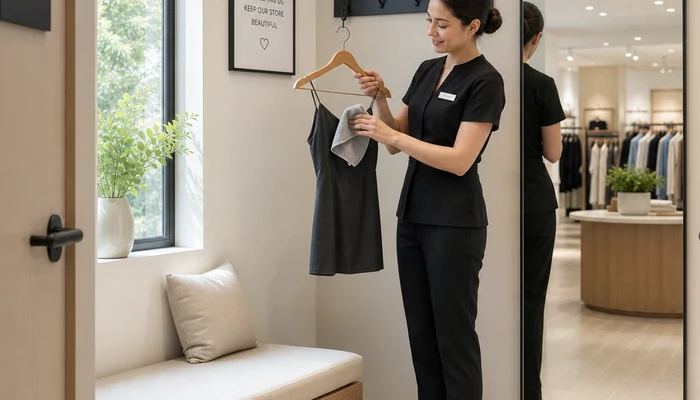
A reset is a short readiness check, not a substitute for scheduled cleaning. After a customer leaves, staff can collect unwanted merchandise, return hangers to the designated area, remove visible debris, and confirm that the room can be used safely. If the room is visibly soiled, staff should clean the affected area rather than simply making it look tidy.
A reset can also reveal issues that are easy to miss when employees focus only on merchandise. Check for a wet patch, broken hook, loose fixture, damaged curtain, discarded packaging, or an item left behind. Report concerns through the store’s usual process. Do not put a room back into use if a spill, sharp object, bodily-fluid incident, or other hazard needs a specific response.
Cleaning removes soil with a method suited to the surface
Routine cleaning addresses ordinary dust, fingerprints, marks, and debris. The cloth, tool, and product should suit the surface and the manufacturer’s care guidance. A product that is suitable for a hard counter may damage a mirror coating, painted wall, upholstery, or floor finish. Staff should follow the product label and the retailer’s procedure rather than mixing chemicals or improvising concentrations.
Disinfection requires label directions and a defined purpose
Disinfection is not simply spraying a product and wiping immediately. The product label identifies appropriate uses and surfaces, application directions, and required wet contact time. If the surface dries too soon, the directions may not have been followed. Staff should not claim that every fitting-room surface is disinfected after every visit unless the store’s actual procedure supports that statement.
Public-health information can help teams understand why hygiene communication and sound practices matter, but it does not replace product labels or local requirements. The World Health Organization’s public-health updates provide broad context on health topics; retailers should use their own risk assessment and applicable guidance when setting site-specific procedures.
Map the room into high-touch, visual, and easily missed zones
High-touch points need deliberate attention
Door handles, hooks, latches, switches, benches, and frequently touched edges may receive repeated contact. Identify the actual touchpoints in each room instead of relying on a generic list. A store with a curtain and wall-mounted hooks has different contact points from one with a hinged door and a built-in seat.
Include the path customers use to enter and exit. A fitting room may be clean inside while a nearby queue rail, door pull, or shared waiting bench is not. The goal is not to disinfect every object constantly; it is to identify practical touchpoints and assign them a suitable cleaning frequency.
Visual surfaces create an immediate impression
Mirrors, floors, seating, walls near the bench, and the door or curtain are highly visible. Check mirrors for streaks and fingerprints under the lighting customers use. Look at the floor from standing height and from the doorway, since loose tags, lint, dust, and hair can be noticeable from either position. Clean what is visibly soiled and use a material-compatible method.
Edges and fixtures can escape a quick glance
Hooks, corners, baseboards, curtain hems, door tracks, and the undersides or edges of seating can collect dust and small debris. These areas may not need attention after every customer, but they belong on the scheduled inspection list. Include any built-in ledge or shelf where shoppers place personal belongings or merchandise.
For an additional perspective on customer-facing spaces, see the discussion of cleanliness in commercial customer-service areas. Apply the ideas selectively: a fitting room has privacy, turnover, and material considerations that a general customer area may not.
Use a repeatable inspection sequence from doorway to exit
Begin with safety and room status
Before entering, check whether the room is occupied and follow store privacy procedures. When it is available, look for hazards before touching or moving anything. A wet floor, broken fixture, discarded sharp item, or unusual spill changes the task from a routine reset to an incident response. Follow the retailer’s escalation procedure and keep the space closed when needed.
Work through a fixed route
A consistent route reduces omissions. Staff might begin at the entrance and move clockwise, checking the door or curtain, touchpoints, mirror, seating, floor, and fixtures. The precise route matters less than using the same one every time and making sure the checklist matches the room design.
- Confirm the room is unoccupied and safe to enter.
- Remove abandoned merchandise and loose rubbish according to store procedures.
- Inspect the mirror, seating, floor, hooks, handles, and other listed surfaces.
- Clean visible soil with the correct tool and approved product.
- Check for damage, spills, odors, or maintenance concerns.
- Return the room to a ready state and record exceptions when required.
Finish with a readiness check
Step back and check the room as a customer would. Is there clear floor space? Can the door or curtain close? Is the mirror unobstructed? Is seating free of visible debris? Are there any items or tools left behind? This last glance catches small problems that a task-by-task sequence may not reveal.
For stores with multiple rooms, a checklist should make it possible to identify which room was checked, when, and by whom, without creating an unnecessarily burdensome record. If a full log is impractical for every reset, document scheduled inspections and exceptions in a way supervisors can verify.
Choose inspection frequency around traffic and risk
Use a baseline, then adjust to observed conditions
There is no single interval that suits every fitting room. Traffic volume, the number of rooms, staffing, season, merchandise type, and the condition of the space all affect how quickly a room needs attention. A quiet boutique may need a different cadence from a high-volume location during a weekend promotion. Set a baseline and review it using actual inspection findings.
At minimum, decide who checks a room after use, who completes scheduled cleaning, and who verifies the work. If staff cannot consistently complete the assigned tasks during busy periods, the schedule may be unrealistic. Adjust staffing or the scope of the routine rather than allowing the checklist to become a formality.
Match the interval to what the check is meant to achieve
Between-customer resets mainly restore readiness and catch immediate issues. Opening checks confirm that rooms are prepared for the day. Periodic checks address visible soil and high-touch surfaces in a planned way. Closing tasks give the team time to clean broader areas and record maintenance needs. These functions should not be collapsed into a single vague instruction.
| Check type | Purpose | Examples of appropriate tasks |
|---|---|---|
| After use | Restore immediate readiness | Remove left items and rubbish, inspect the floor and seating, report hazards |
| Scheduled during trading | Maintain condition as traffic changes | Inspect touchpoints, visible surfaces, mirrors, and any emerging soil |
| Opening or closing | Prepare or reset the full area | Review all rooms, complete assigned surface cleaning, note repairs and supply needs |
| Periodic detail review | Catch buildup and deterioration | Inspect edges, tracks, corners, fixture condition, and less accessible surfaces |
Change the cadence when conditions change
Increase attention when inspections repeatedly find debris, visible marks, or supply problems before the next planned check. Reassess after a layout change, a promotional event, a rush period, or a rise in customer volume. Conversely, avoid adding checks that do not improve readiness or hygiene. The evidence from the room should guide the schedule.
Retail teams looking at broader sales-area routines may also find this overview of sales and customer-service area upkeep useful. Use it as context, then build a fitting-room-specific schedule around room turnover and privacy.
Build a checklist that employees can complete during a real shift
Make each item observable
A useful checklist names a surface or condition and a clear action. “Check cleanliness” gives little direction. “Inspect mirror for visible fingerprints; clean if marked using the approved glass method” gives the employee a decision point. Keep instructions short enough to use during service, and add a reference for unusual situations rather than crowding every task into the routine list.
Separate routine tasks from exceptions
Staff should be able to tell the difference between ordinary cleaning and a situation requiring a supervisor or trained responder. A checklist might include a simple exception category for spills, bodily fluids, broken glass, sharp objects, damage, persistent odor, or a suspected pest concern. The response should follow store policy and product instructions; routine tools and cloths should not be used for an incident outside their intended purpose.
- Room number or location is identifiable.
- Room is confirmed vacant before work begins.
- Merchandise, rubbish, and lost items are handled according to store policy.
- Named surfaces are inspected and cleaned when visibly soiled.
- Products and tools match the surface and task.
- Hazards, damage, and supply needs are reported.
- Room is checked for customer-ready condition before reopening.
Keep ownership clear across roles
In some stores, sales associates handle quick resets while a cleaning team handles scheduled work. In others, the same employee does both. Either model can work if responsibilities are explicit. Define who replenishes supplies, who checks logs, who handles an unavailable room, and who contacts maintenance when a fixture is damaged.
For professional cleaning programs, Nilfisk’s equipment and cleaning solutions offer manufacturer information about equipment categories and applications. Such product information can inform equipment selection, but retailers should also check their surface manufacturers’ instructions and the cleaning-product label before using a tool or chemical in a fitting room.
Protect materials, merchandise, and customer belongings
Match products to the surface
Fitting rooms can combine glass, mirrors, coated metals, painted walls, laminate, tile, resilient flooring, fabric seating, and specialty finishes. A product that works on one may leave residue or damage another. Maintain a simple surface-and-product reference approved by the retailer, and test unfamiliar methods in an inconspicuous area when the manufacturer recommends it.
Never mix cleaning chemicals. Follow label directions for dilution, ventilation, personal protective equipment, application, and contact time. Keep products in their original labeled containers or in properly labeled secondary containers as required by the store’s procedures. Do not leave chemicals, tools, or wet surfaces where customers could encounter them.
Prevent transfer between rooms and tasks
Use a system that helps staff keep tools appropriately clean and assigned. Color coding or clearly separated cloths can reduce accidental use of a tool from one task on another. Change or launder reusable materials according to the retailer’s procedure, and do not keep using a cloth that is visibly soiled. Store tools away from merchandise and customer belongings.
Respect privacy and personal property
Cleaning staff should follow clear rules about entering a room, checking that it is vacant, and handling items left behind. Do not inspect personal bags or move belongings beyond what is necessary for safety and the store’s lost-property procedure. If something is found, record or transfer it using the retailer’s established process. A clean room must also feel respectful and secure.
Responsibility for product selection, room access, lost property, and incident response rests with the retailer. A cleaning provider should work within the site’s instructions, communicate concerns, and avoid making assumptions about merchandise or personal items.
Handle spills, odors, and damage as exceptions—not quick fixes
Close the room when routine cleaning is not enough
Some conditions need more than wiping and resetting. A liquid spill can create a slip risk; broken hardware can injure a customer; an unknown substance may require specific handling. Follow the store’s incident procedure, restrict access if necessary, and notify the designated supervisor. Do not reopen a room simply because the visible mark has disappeared.
Investigate recurring odors at the source
Fragrance or air freshener may mask an odor without removing its cause. Check for damp material, waste, a spill beneath seating, or a drain or ventilation issue where applicable. Persistent odors should be reported so the retailer can investigate building maintenance or material concerns. Avoid using strong scents that may bother customers or conflict with store policy.
Record damage and recurring trouble spots
Repeated marks on the same wall, loose hooks, a failing latch, a curtain that drags on the floor, or residue that quickly returns may point to a maintenance issue rather than a cleaning failure. A useful report includes the room, what was observed, when it was noticed, and whether the space was taken out of use. Photos may help where store policy permits and no private customer information is captured.
Reviewing the cleaning and condition of customer-facing spaces as a whole can help retailers spot recurring issues. The key is to route each issue to the right person: cleaning staff remove ordinary soil, while facilities or management address broken fixtures, building defects, and product-related damage.
Verify the standard with observations, not paperwork alone
Use a short quality review
Supervisors should periodically compare the written checklist with what is actually happening in the room. Check whether the named surfaces look ready, whether staff follow the required product directions, and whether reported exceptions receive follow-up. A completed box is useful evidence of process, but it does not prove that a surface was cleaned correctly.
Choose a few clear measures rather than a complicated scoring system. Examples include the share of inspected rooms ready for use, repeated findings by room, response time for reported hazards, and whether required scheduled tasks were completed. Interpret results carefully: a room can look tidy yet still need a particular cleaning step, and a single missed check should prompt fact-finding rather than blame by default.
Ask staff what prevents consistent results
Employees often know why a standard slips: the checklist is hard to find, supplies are stored far away, the route conflicts with customer flow, or the assigned interval does not match traffic. Ask for specific examples and adjust the process when appropriate. Training should demonstrate the actual room surfaces and products, not rely only on a written procedure.
Review after a change or complaint
Revisit the protocol when rooms are renovated, new materials are installed, a customer complaint reveals a missed point, or inspections show repeated buildup. Update training and product references at the same time as the checklist. This keeps the written standard aligned with the room employees actually work in.
A broader discussion of cleaning and disinfecting practices for shared areas can provide useful general context. A retailer should still tailor its procedure to the fitting room, applicable product labels, surface guidance, and store risk assessment.
Evaluate a cleaning partner by the fitting-room process
Ask for scope by surface and visit type
Before appointing a provider, ask which fitting-room surfaces are included in routine work, which tasks happen on a scheduled basis, and what falls outside the agreed scope. Confirm whether the work covers mirrors, seating, floors, touchpoints, fixtures, and less accessible edges, as relevant to the location. Ask how staff record work and flag a room that cannot safely be returned to use.
Check training, communication, and product controls
A useful provider can explain how employees learn site procedures, how they identify a vacant room, how they protect merchandise and customer belongings, and how they select products for different surfaces. Ask how substitutions are approved and what happens when a product or tool is unavailable. Clear communication matters as much as a detailed task list.
Make the service plan fit store operations
Talk through opening hours, peak traffic, access arrangements, room counts, and the retailer’s expectations for customer privacy. A plan that disrupts shoppers or leaves wet floors during a rush is not a good fit. Agree on a contact for urgent issues, the process for schedule changes, and how management reviews quality.
For a service-specific overview, retailers can review retail store cleaning options and compare the proposed scope with their own fitting-room checklist. A provider’s stated scope should be confirmed directly, including timing, responsibilities, and any excluded tasks.
Apply the standard to different store layouts and traffic patterns
Small shops need a compact routine
A shop with one or two fitting rooms may rely on a small team that also handles sales. Keep the reset short, place approved supplies where staff can access them safely, and establish who covers the check when the assigned employee is helping a customer. A minimal checklist can still be thorough if it names the room’s actual touchpoints and gives clear escalation steps.
High-volume stores need coordination
Multiple rooms and busy queues create more turnover and more opportunities for tasks to be missed. Use room identifiers, assign coverage by zone or time block, and make the room’s status visible to the team without compromising customer privacy. A supervisor can sample-check rooms during peak periods to see whether the planned cadence is realistic.
Seasonal changes can alter the workload
Promotions, holiday shopping, weather, and changes in merchandise can affect the type and amount of debris. A winter coat section, for example, may bring more lint or moisture-related concerns than a lighter summer assortment. Adjust the observed checks to actual conditions rather than assuming the same pattern throughout the year.
Stores in Chicago, Illinois may also plan for seasonal foot traffic and weather-related debris at entrances, while keeping fitting-room procedures tied to the conditions found inside the store. Local context can inform scheduling, but it does not replace a site-specific inspection.
Fitting room standards: frequently asked questions
How often should fitting rooms be checked?
Check rooms after use for immediate readiness and safety concerns, then schedule broader inspections based on traffic, room condition, staffing, and the store’s risk assessment. Review the interval when inspections reveal repeated problems. There is no universal frequency that fits every retailer.
Should a fitting room be disinfected after every customer?
That depends on the retailer’s risk assessment, procedures, applicable guidance, and the product directions for the surfaces involved. A quick reset is not automatically disinfection. If disinfection is part of the procedure, staff must use an appropriate labeled product and follow its directions, including contact time.
Which fitting-room surfaces should be prioritized?
Prioritize surfaces that are frequently touched, visibly soiled, or important to customer readiness. Common examples include handles, latches, hooks, seating, mirrors, floors, and curtains or doors. Adjust the list to the actual layout and finish materials.
Can staff use one cleaner on every surface?
Not safely by assumption. Mirrors, coated metals, painted surfaces, fabrics, and flooring may have different care requirements. Follow the product label and the material manufacturer’s guidance. Do not mix products or use an unapproved substitute.
What should staff do about a spill or broken fixture?
Follow the retailer’s incident process, notify the designated person, and keep the room unavailable if there is a hazard. Some incidents require trained responders or specialized products. Routine cleaning should not replace the procedure for an unknown spill or physical hazard.
How can a store tell whether its checklist works?
Compare checklist records with periodic room observations, recurring issues, staff feedback, and follow-up on exceptions. If tasks are repeatedly missed, review whether instructions, staffing, supply access, training, or timing need adjustment.
What information should a cleaning provider be able to explain?
The provider should be able to describe the agreed scope, methods for room access and privacy, how products are matched to surfaces, how work is documented, and how hazards or maintenance problems are reported. Confirm these details for the specific site rather than relying on a generic promise.
Turn the checklist into a dependable customer experience
Fitting Room Cleaning Standards That Protect Retail Customer Trust work best when they connect three things: a room-specific checklist, a realistic inspection rhythm, and a clear response to exceptions. Resetting after use restores order; scheduled cleaning addresses visible soil; disinfection, when required, follows product directions and a defined procedure. Staff should know what they own and what to report, while supervisors verify outcomes instead of relying on completed forms alone.
Start by walking every fitting room and listing its materials, touchpoints, fixtures, and likely trouble spots. Then assign actions and frequencies, check that supplies and instructions are accessible, and review the process after the first few weeks. Adjust based on observed traffic and findings. If you are comparing a broader retail cleaning scope, review retail cleaning service details and discuss how the provider’s process can fit your store’s operating needs.
About CHI Cleaning Services
CHI Cleaning Services supports a range of residential and commercial cleaning needs, including recurring house cleaning, deep cleaning, move out cleaning, office cleaning, and facility cleaning. Trained staff use consistent checklists and quality standards, with professional products and equipment selected as appropriate for the surfaces and scope. Scheduling options and availability depend on the project and current schedule.
CHI Cleaning Services helps households and businesses in Chicago, Illinois and nearby areas keep their spaces clean and healthy. Clear communication, attention to detail, and long-term client relationships guide the company’s approach. For work in a retail environment, the service scope, access arrangements, timing, and site-specific requirements should be discussed before work begins.
professional cleaning services, store cleaning Cleaning Services Chicago, retail cleaning services, retail store cleaning West Dundee, store cleaning Harvey IL, shop cleaning Cragin, storefront cleaning Waco, retail cleaning Crest Hill, retail floor cleaning La Grange, boutique cleaning Markham IL